
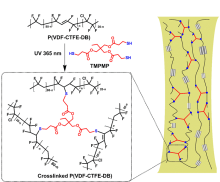
 04/25/2024Novel Approach for Fabricating Elastic Ferroelectrics by Thiol-Ene Click Reaction
A research group led by Prof. LI Runwei and HU Benlin at the Ningbo Institute of Materials Technology and Engineering (NIMTE) of the Chinese Academy of Sciences (CAS) designed a facile and efficient approach to fabricate elastic relaxor ferroelectrics via thiol-ene click reaction.
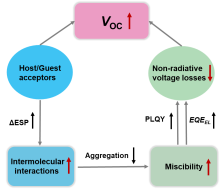 04/15/2024Novel Method to Design High-Efficiency Guest Components for Ternary Organic Solar Cells
A research group led by Prof. GE Ziyi at the Ningbo Institute of Materials Technology and Engineering (NIMTE) of the Chinese Academy of Sciences (CAS), has proposed a key strategy for optimizing guest components to minimize non-radiative voltage losses, thus achieving high-efficiency ternary organic solar cells (OSCs).
This work was published in Advanced Materials.
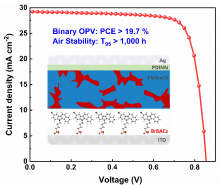 03/28/2024NIMTE Sets New Record for Efficiency of Stable Binary Organic Solar Cells
A research group led by Prof. GE Ziyi from the Ningbo Institute of Materials Technology and Engineering (NIMTE) of the Chinese Academy of Sciences (CAS), has developed two self-assembled molecules (SAMs) with large dipole moments and employed them as hole-transporting layers (HTLs) in binary organic solar cells (OSCs), achieving highly efficient and stable binary OSCs with a...
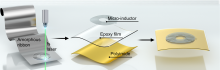 03/28/2024Scientists Develop Novel Amorphous Flexible Mini-Inductor
Prof. WANG Junqiang’s team at the Ningbo Institute of Materials Technology and Engineering (NIMTE) of Chinese Academy of Sciences (CAS), developed a mini-inductor based on amorphous alloys, which can achieve both excellent flexibility and high inductance. The study was published in Advanced Functional Materials.
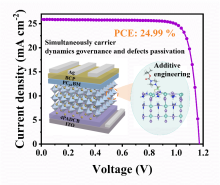 03/25/2024Novel Multifunctional Additive Boosts Efficiency and Stability of Inverted PSCs
Prof. GE Ziyi’s team at the Ningbo Institute of Materials Technology and Engineering (NIMTE) of Chinese Academy of Sciences (CAS), developed a novel multifunctional additive to passivate defects and promote carrier transport, thus boost efficiency and stability of inverted perovskite solar cell (PSCs). The study was published in Angewandte Chemie International Edition.