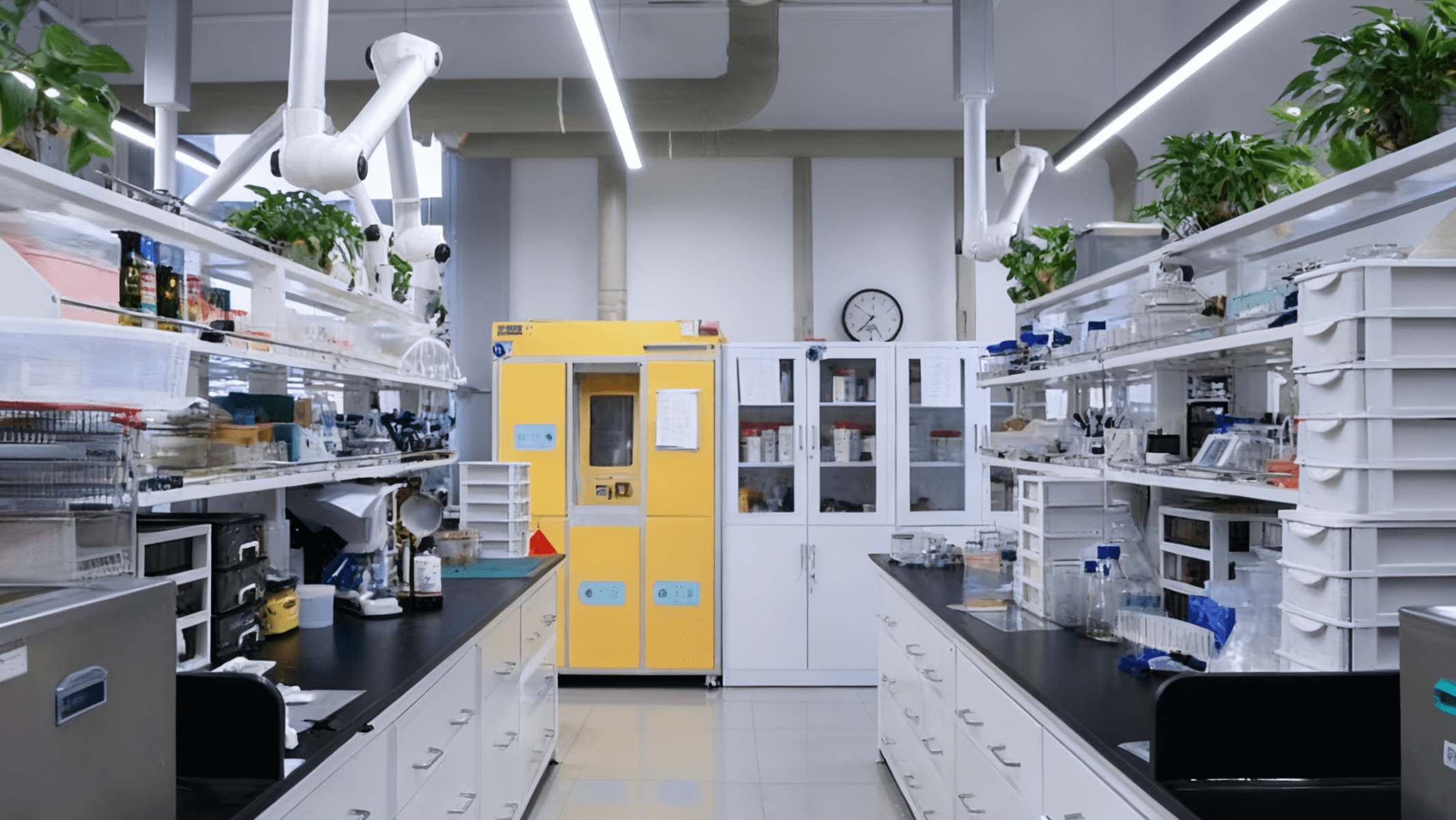
Researchers at the Ningbo Institute of Materials Technology and Engineering (NIMTE) of the Chinese Academy of Sciences (CAS) have unveiled the Robotic Marine Materials Scientist Platform, an intelligent fabrication system that dramatically improves materials R&D efficiency over conventional approaches.
Traditional materials research faces two long-standing bottlenecks: valuable experimental data from failed trials are often lost, hindering artificial intelligence (AI) model training, while repetitive manual operations consume time and introduce errors.
To address these challenges, researchers at NIMTE developed the Robotic Marine Materials Scientist Platform for severe marine environments: high temperature, high pressure, high speed, high salinity, and high humidity. The platform automates the entire workflow—from design and preparation to testing and feedback. Robots act as "materials scientists" and carry out these tasks autonomously, significantly accelerating the materials innovation cycle.
Working in synergy with the "MarineMat AI" assistant, the platform creates a closed-loop R&D system that spans AI-driven design, automated fabrication, characterization, and data feedback. All experimental parameters are automatically recorded and structured for model iteration, with AI prediction accuracy exceeding 90%.
Using this platform, the team has developed a novel multi-component cermet composite with excellent temperature and wear resistance, achieving over 30% improvement in mechanical and tribological performance over conventional ternary materials.
The screw drills made from this material have been deployed in the Chuanke-1 scientific exploration well in southwest China at depths of 7,500 to 10,000 meters, replacing imported components and supporting China’s ultra-deep well drilling efforts.
The platform frees scientists from repetitive work, enabling them to focus on higher-level scientific discovery. By generating high-quality experimental data that continuously strengthens AI models, this virtuous cycle drives innovation in marine materials and promises strong application potential.
Robotic Marine Materials Scientist Platform