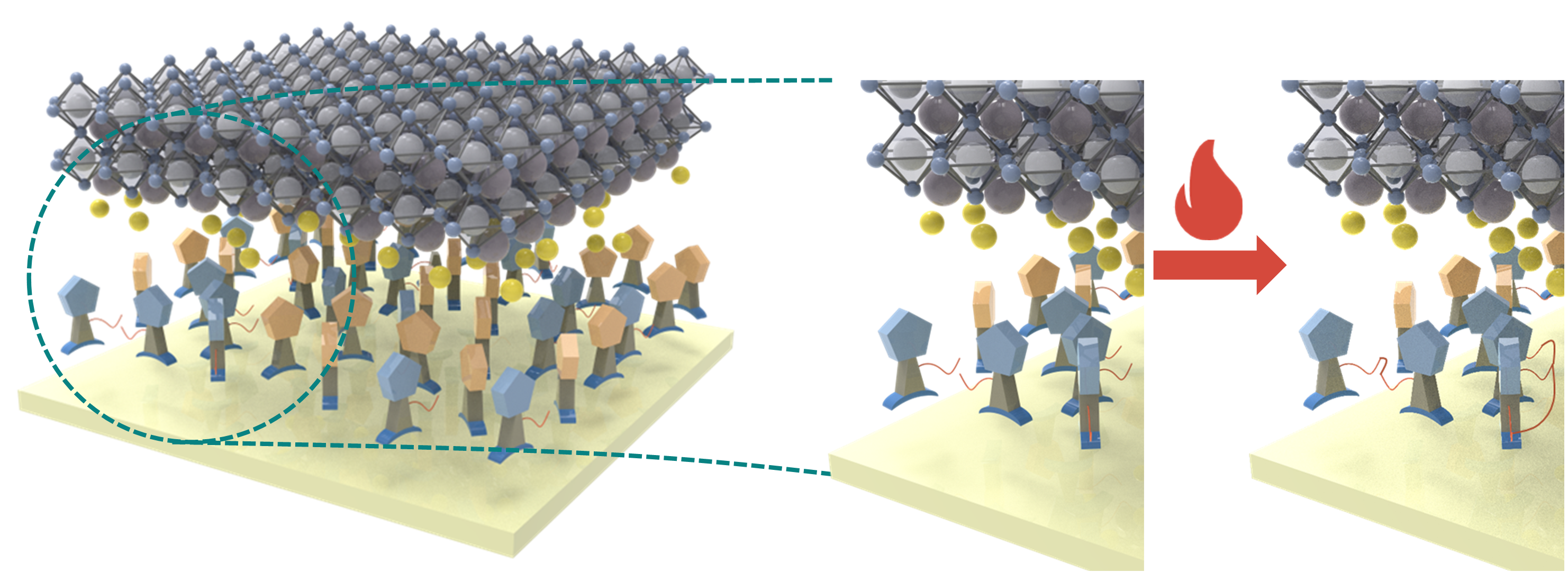
Prof. GE Ziyi's group from the Ningbo Institute of Materials Technology and Engineering (NIMTE) of the Chinese Academy of Sciences (CAS) has developed a molecular locking strategy to stabilize the interface between the electrode and the hole-transport layer in organic solar cells (OSCs), enabling large-area, highly efficient, and stable photovoltaic devices.
The study was published in Joule on October 21.
OSCs are devices that convert sunlight into electricity using carbon-based organic materials rather than the silicon used in conventional solar panels. OSCs feature solution processability, mechanical flexibility, low-cost fabrication, and compatibility with large-area manufacturing. They also deliver impressive laboratory efficiencies, making them a leading candidate for next-generation photovoltaics.
However, forming dense, stable self-assembled monolayer (SAM) contacts on indium tin oxide (ITO) surfaces remains challenging. These contacts tend to desorb under continuous light and heat, thus limiting the commercial application of OSCs on a large scale.
To address this unstable interface issue, researchers at NIMTE proposed a molecular locking strategy. Using a vacuum-deposited InClx interlayer, they triggered ligand exchange to form a robust multidentate In-O-P coordination network that densely and uniformly anchors SAMs.
Based on this molecular locking interface, small-area OSCs developed by the researchers achieved a power conversion efficiency (PCE) of 20.4%.
"We scaled the technique to large-area modules with an aperture area of 15.6 cm2, reaching an active-area PCE of 18.8%, one of the highest reported values for SAM-based organic photovoltaic modules," said Prof. LIU Quan, a corresponding author of the study.
The devices also retained over 85% of their initial efficiency after 2,000 hours of maximum power point tracking at 25 °C, demonstrating excellent stability.
This strategy provides a universal interface platform for efficient, stable, and scalable organic photovoltaic modules, showing promise for overcoming the long-standing trade-off between efficiency, stability, and scalability.
This work was supported by the National Natural Science Foundation of China (Nos. 52673251, 22475225 and U21A20331) and the Key Program of Ningbo Public Welfare Research Plan (Grant No. 2025S007).
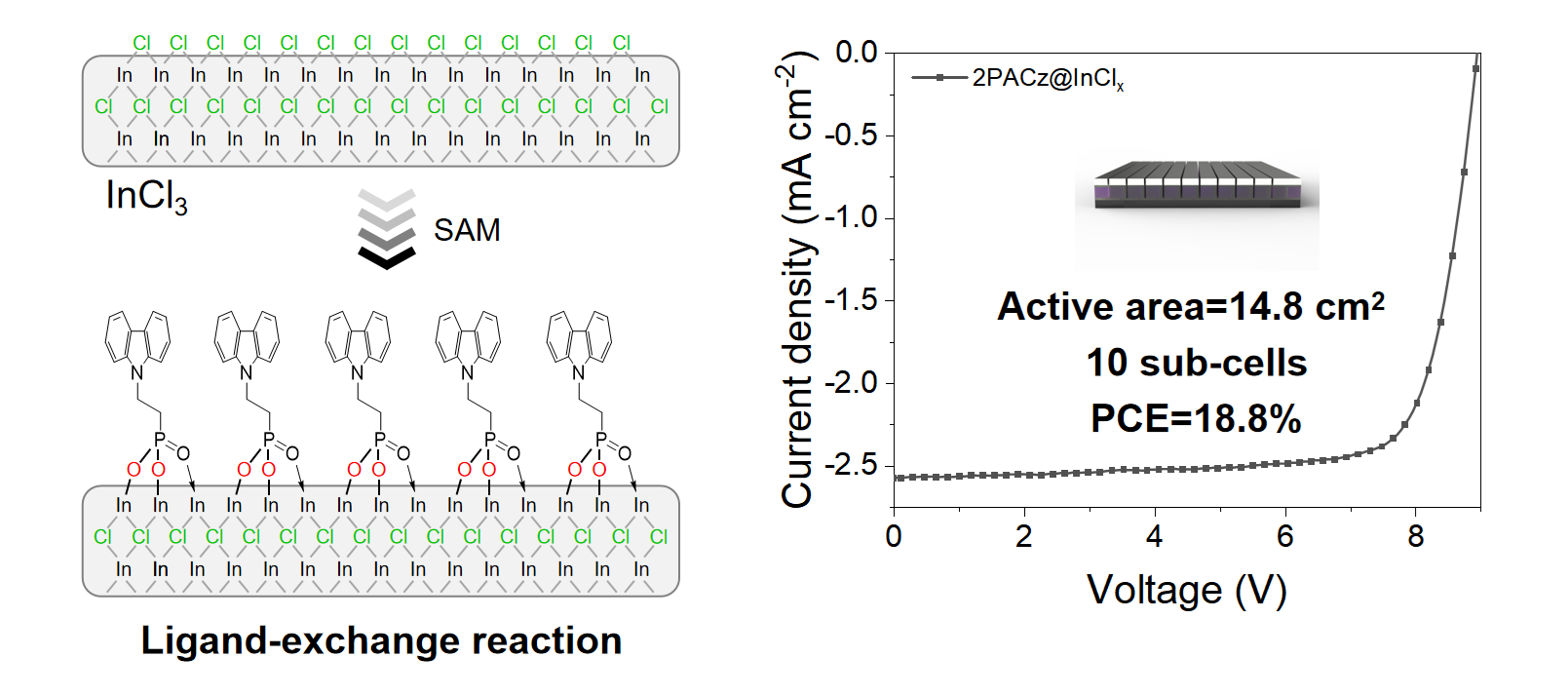
The interface diagram and performance of organic solar cells based on the molecular locking strategy (Image by NIMTE)