Prof. YE Jichun’s team from the Ningbo Institute of Materials Technology and Engineering (NIMTE) of the Chinese Academy of Sciences, in collaboration with Jietai New Energy Technology Co., Ltd., has innovatively proposed a synergistic technical solution that allows industrial tunnel oxide passivating contact (TOPCon) solar cells to achieve high efficiency, low cost, and excellent bifacial power generation performance simultaneously.
The study was published in Joule.
TOPCon solar cells have emerged as a mainstream photovoltaic technology in the current crystalline silicon photovoltaic market, accounting for over 70% of market share due to their high power conversion efficiency (PCE), cost advantage, and mass production capability.
However, their industrial advancement faces pressing challenges, including high silver paste consumption, notable parasitic optical loss, and limited bifacial performance, which collectively hinder further improvements in efficiency and cost reduction.
To address these issues, the researchers at NIMTE have developed a technical solution that can be directly applied to mass production. Leveraging industrial M10 silicon wafers, the solution adopts a high-precision steel-stencil printing process to fabricate the front metal fingers of the cells, and innovatively designs a localized polysilicon contact structure on the rear side.
The front steel-stencil printing process enables the production of ultra-narrow metal fingers, reducing the silver paste consumption of the cells by 0.12 mg/W.
Combined with the modified silver paste, dense nanosilver clusters can be formed at the contact interface between the electrodes and the silicon substrates, lowering the contact resistivity to 2.4 mΩ·cm2.
Meanwhile, the localized structure design on the rear side effectively reduces parasitic optical absorption, increasing the cell bifaciality to approximately 90%.
With these innovations, the team fabricated an industrial TOPCon solar cell with a certified PCE of 26.09%. This strategy successfully breaks the traditional trade-offs among efficiency, cost, and bifacial performance.
This work provides a viable and scalable solution for manufacturing high-performance, low-cost TOPCon cells, reinforcing their role as a core technology for future terawatt-scale photovoltaic deployment.
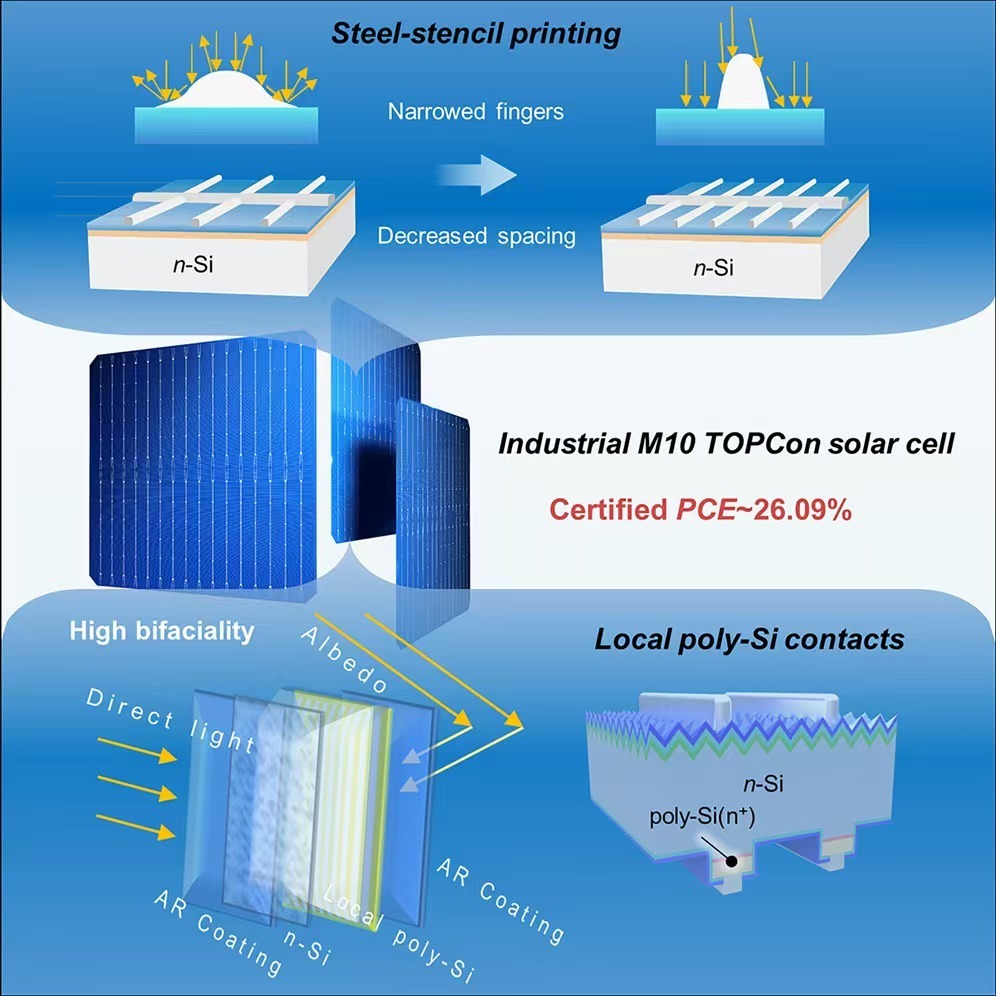
Fig. The high-efficiency industrial TOPCon solar cells (Image by NIMTE)